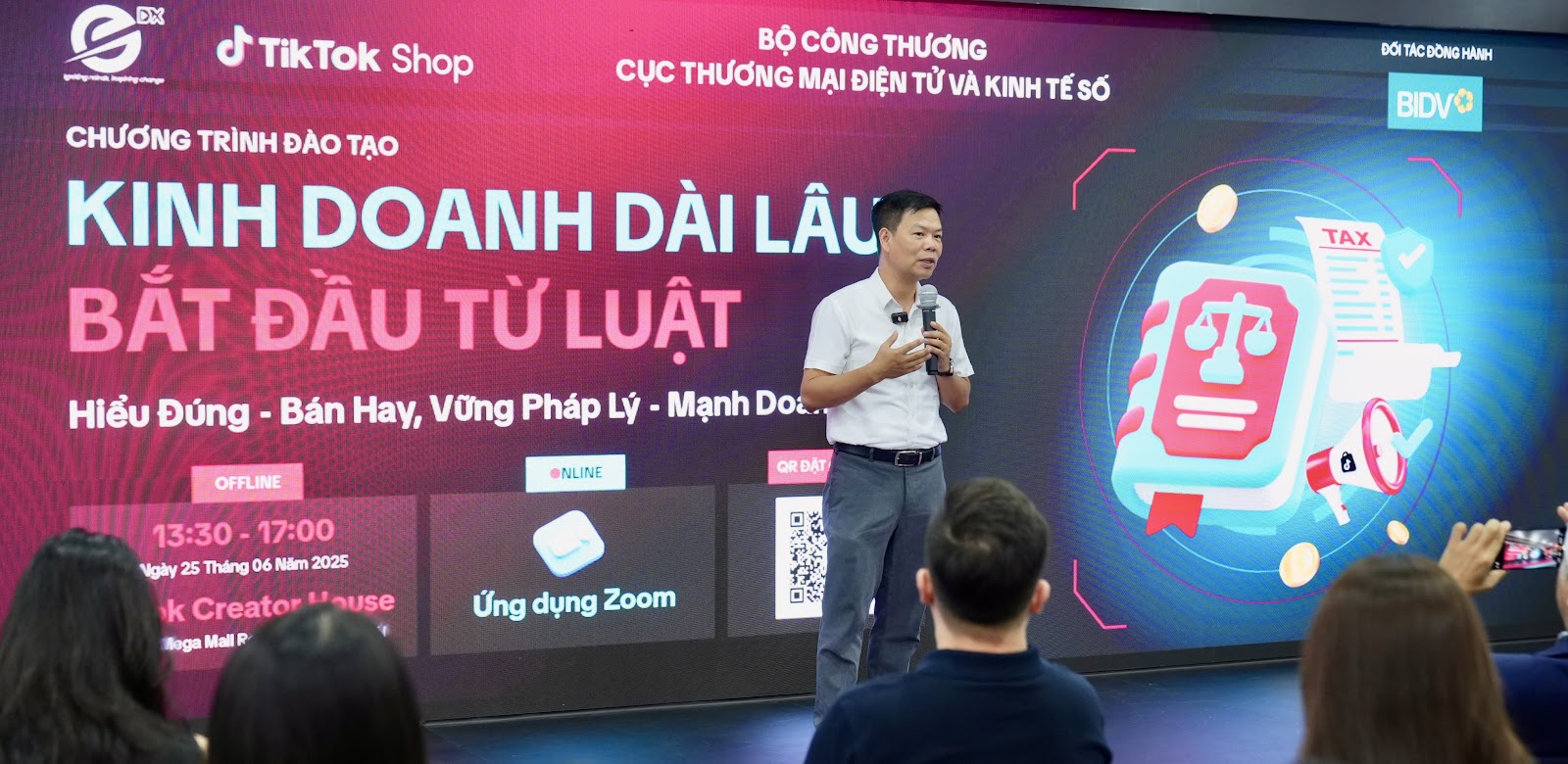
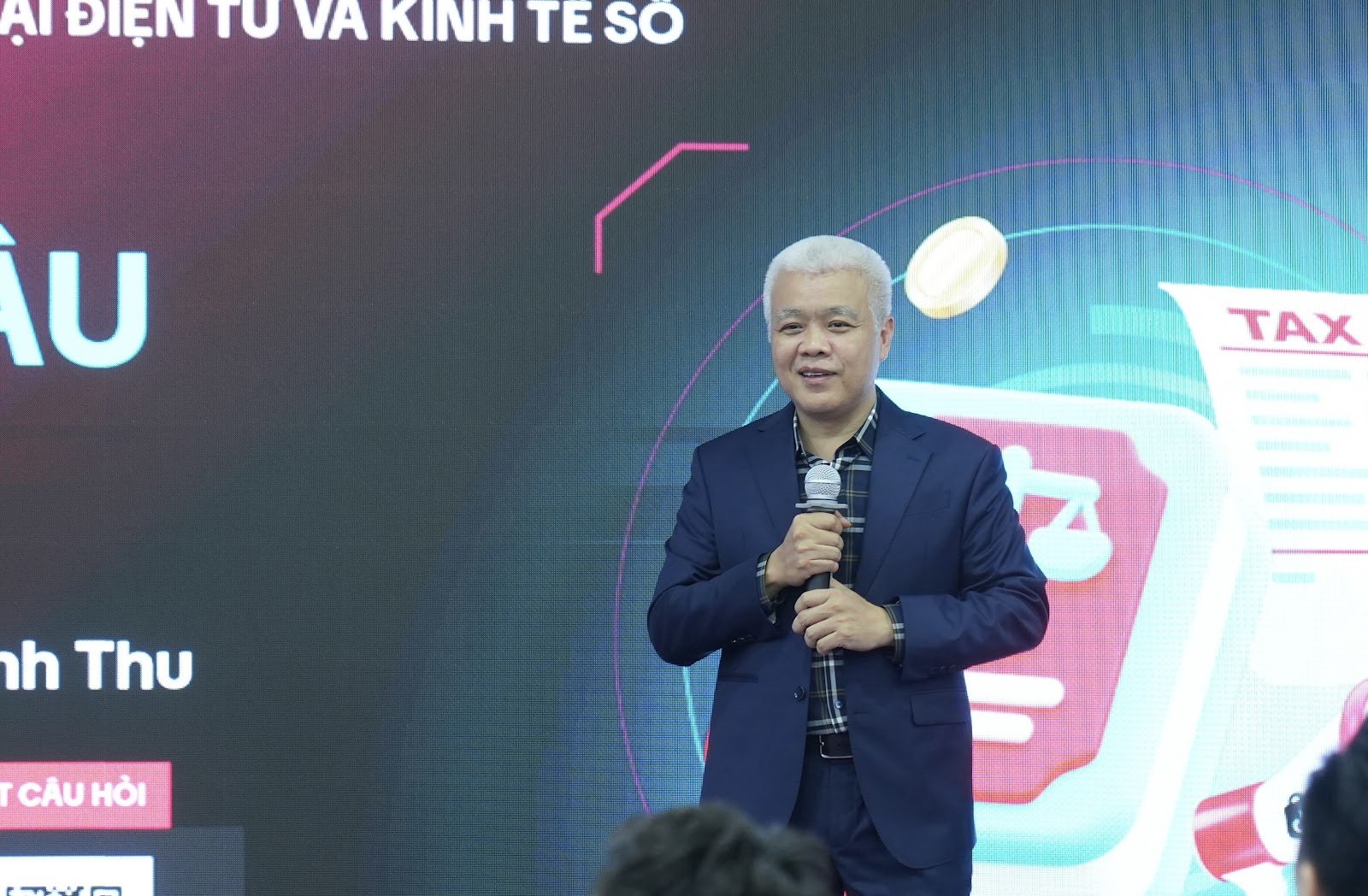
On the afternoon of June 25, 2025, in Hanoi, the Center for E-commerce and Digital Technology Development (eComDX), under the Department of E-commerce and Digital Economy (Ministry of Industry and Trade), collaborated with TikTok Vietnam, BIDV Bank, and e-commerce operational consulting firms to organize a training program themed “Sustainable Business – Starting with the Law”. The program aimed to raise awareness and improve compliance with the law in the increasingly developing digital environment.
The event attracted widespread attention from the e-commerce community, with the participation of over 700 sellers and affiliate marketing creators, along with many businesses and experts in the e-commerce field.
Clear legal framework – the foundation for a transparent market.
Mr. Nguyen Huu Tuan, Director of the Center for E-commerce and Digital Technology Development (eComDX), Department of E-commerce and Digital Economy (Ministry of Industry and Trade)
At the event, Mr. Nguyen Huu Tuan, Director of the Center for E-commerce and Digital Technology Development (eComDX), Department of E-commerce and Digital Economy (Ministry of Industry and Trade), provided an overview of the current legal framework, e-commerce business conditions, and especially the issues of concern in the Draft Law on E-commerce. According to Mr. Tuan, perfecting the legal framework is a key factor in ensuring the sustainable and transparent development of this sector in Vietnam.
Mr. Tuan emphasized that the legal system for e-commerce in Vietnam has been and is being built quite comprehensively, based on core documents. Starting with Decree 52/2013/ND-CP and amended and supplemented by Decree 85/2021/ND-CP, this serves as a guiding principle for the development, application, and management of e-commerce. "These decrees, along with guiding circulars and related laws such as the 2023 Electronic Transactions Law, the Commercial Law, and the Law on Consumer Protection, have created a fairly complete legal framework, regulating everything from notification and website registration to issues of electronic contracts, payments, and dispute resolution," Mr. Tuan stated.
E-commerce Business Conditions: Responsibilities and Compliance
Regarding the conditions for conducting e-commerce business, Mr. Tuan pointed out that sellers and e-commerce platforms need to strictly comply with regulations to ensure a healthy business environment. "For sellers, the prerequisite is having clear legal status, providing accurate information about themselves and their goods and services, and publicly disclosing sales policies such as returns and warranties," Mr. Tuan explained. In particular, notifying or registering the e-commerce website/application with the Ministry of Industry and Trade is mandatory.
For e-commerce platforms, the responsibility is even heavier. The director of eComDX emphasized that platforms must register with the Ministry of Industry and Trade, establish transparent operating regulations, set up mechanisms for information control, and support dispute resolution. Platforms also need to require sellers to provide complete legal information and cooperate closely with state management agencies in preventing counterfeit and pirated goods.
Rights and obligations of sellers and e-commerce platforms: Clarity and Sharing
Mr. Tuan further clarified the responsibilities of each party. The seller is primarily responsible for the quality of goods and services, the accuracy of product information, fulfilling sales commitments, and protecting the personal information of buyers.
Meanwhile, e-commerce platforms act as intermediaries, responsible for ensuring a safe and reliable trading environment. "The platform must control information, prevent illegal activities on its platform, support complaint resolution, and provide necessary information to state management agencies when requested. In particular, the responsibility for joint compensation for damages in certain cases if management obligations are not properly fulfilled is being carefully considered during the drafting of the new law," Mr. Tuan emphasized.
To maintain market order, Mr. Tuan also outlined prohibited behaviors and corresponding penalties. "Behaviors such as failing to notify/register websites, trading in counterfeit goods, prohibited goods, imitation goods, false advertising, tax evasion, infringement of personal information, or cyberattacks are all strictly prohibited," Mr. Tuan affirmed.
Regarding sanctions, depending on the severity of the violation, the entities involved may be subject to administrative penalties (fines, confiscation of evidence, suspension of operations, revocation of licenses) according to specialized decrees. "For more serious cases causing significant consequences, the violation may be prosecuted under the Criminal Code. In addition, civil compensation is also an important sanction to protect the rights of the parties involved," Mr. Tuan added.
Improving the Law on E-commerce: A Perspective from the Draft
The highlight of the program, as shared by Mr. Nguyen Huu Tuan, was the issues currently being hotly debated in the draft Law on E-commerce. This is an important legal document, expected to enhance the effectiveness and efficiency of state management. At the same time, the new law aims to keep pace with the explosion of new business models in the digital age. However, Mr. Tuan also frankly acknowledged that the draft currently faces many challenges that need careful consideration. One of the biggest issues is defining the scope of regulation, avoiding overlaps with other existing or being enacted specialized laws, such as the Law on Electronic Transactions or the Law on Personal Data Protection, in order to ensure consistency and clarity in application.
Regarding this issue, a major point of contention is the responsibility of e-commerce platforms. The draft tends to strengthen the role of platforms in controlling the quality and origin of goods supplied by sellers. "We are listening to opinions from all parties to find a balance between protecting consumers and not creating an excessive burden that is inconsistent with the nature of the platform as an intermediary," Mr. Tuan shared.
Simultaneously, managing taxes on e-commerce transactions, especially cross-border and social media e-commerce, is also a complex problem requiring effective solutions. The draft also needs to consider simplifying administrative procedures, specifically notification and website registration procedures, to reduce the burden on businesses and shift more strongly towards a strict post-audit mechanism, instead of focusing on pre-auditing. Finally, unifying and clarifying regulations on personal data protection in e-commerce, in accordance with the enacted Law on Personal Data Protection, is also an urgent requirement to ensure user privacy.
Mr. Tuan affirmed that the Ministry of Industry and Trade is making every effort to finalize the draft Law on E-commerce, with the goal of building a solid, transparent, and practical legal framework, thereby promoting the strong development of e-commerce and contributing to the building of the digital economy in Vietnam.
Taxes - An indispensable responsibility in digital business.
Mr. Nguyen Viet Hoa, Head of Tax Management Department No. 2 (Tax Management Department for E-commerce Platforms) under the E-commerce Tax Sub-Department - Ministry of Finance
Also within the framework of the program, Mr. Nguyen Viet Hoa, Head of Tax Management Department No. 2 (Tax Management Department for E-commerce Platforms) under the E-commerce Tax Sub-Department - Ministry of Finance, provided a detailed update on tax policies for individuals and organizations operating on digital platforms. From tax identification number issuance, tax declaration and payment through the platform to common errors and how to fix them, participants had the opportunity to gain a clearer understanding of their financial responsibilities in the e-commerce environment.
Mr. Nguyen Viet Hoa affirmed that the tax sector prioritizes perfecting the legal framework for e-commerce, continuously reviewing and supplementing it to ensure consistency and effectiveness in the face of the rapid development of e-commerce platforms and cross-border business activities. The goal is to create a level playing field, combat tax evasion, while not hindering the development of e-commerce.
Regarding tax declaration and payment via digital platforms, Mr. Hoa assessed this as a major step forward, bringing double benefits by helping businesses, individuals, and household businesses save time and costs through the General Department of Taxation's electronic portal (eTax) or the eTax Mobile application. In particular, the portal for household and individual businesses on e-commerce platforms has made tax declaration more transparent and easier. The use of digital signatures and VNeID electronic identification accounts also contributes to enhanced security and convenience.
He recommended that taxpayers regularly update the HTKK software, carefully check the information, and avoid waiting until the last minute to complete transactions when the network is easily overloaded due to receiving too many declarations simultaneously. He affirmed that the tax sector is always ready to support and accompany the digital business community to ensure the smoothest possible process of fulfilling tax obligations.
TikTok Shop and the legal boundaries in digital content.
Ms. Nguyen Thi Cam Giang, Legal Department of TikTok Shop
From the perspective of TikTok Shop's Legal Department, Ms. Nguyen Thi Cam Giang stated that ensuring compliance with internal policies and current legal regulations is a key factor for the sustainable development of sellers.
TikTok Shop has established a strict policy system regarding content, advertising, and sales. All content must be authentic, not misleading, comply with the list of prohibited and restricted products, and respect intellectual property rights. Advertisements must be consistent, accurate, and landing pages must be of high quality. Regarding sales, sellers must comply with regulations on platform fees, order management, shipping, and settlement, and the sale of counterfeit or pirated goods is strictly prohibited.
To conduct business legally in Vietnam, a representative from TikTok Shop's legal department shared that sellers need to fully comply with all relevant laws and regulations regarding e-commerce, taxation, consumer protection, intellectual property, and data security. Additionally, depending on the product category, certain specialized requirements must also be met.
TikTok Shop has a registration and account verification process, as well as a seller performance rating system. All content is subject to moderation. In case of violations, TikTok Shop applies measures ranging from warnings and content removal to feature restrictions, temporary suspension, or permanent account ban. Sellers have the right to appeal. However, violations of current laws may result in administrative penalties, compensation for damages, or criminal prosecution.
Connect - Collaborate - Develop
Ms. Nguyen Kieu Trang - Head of Wholesale Product Policy Department, BIDV Bank
Besides providing professional content, the program also serves as a bridge between policymakers, technology companies, and financial institutions. Ms. Nguyen Kieu Trang, Head of the Wholesale Product Policy Department at BIDV Bank, introduced credit packages and financial support programs specifically for e-commerce sellers, especially on TikTok Shop.
Accordingly, BIDV focuses on supporting online retailers through three main pillars, combining financial solutions and digital technology. The bank provides flexible loan packages and overdraft limits with competitive interest rates, helping retailers proactively manage capital for inventory, expansion, or short-term capital needs, specifically designed to suit the cash flow of online businesses. BIDV is committed to accompanying retailers through specialized financial advisory services and 24/7 customer support channels via hotline and online platforms, helping retailers answer questions, resolve issues, and maximize the efficiency of using banking services.
A representative from BIDV also shared their perspective on "converting from a household business to a company." According to them, registering a company is not simply about complying with the law, but also brings many strategic benefits such as: Benefiting from the corporate income tax exemption policy for small and medium-sized enterprises (SMEs) for the first three years of establishment, helping to reduce operating costs and optimize profits; easier access to credit packages and preferential loans from banks specifically for SMEs converting from household businesses; and enhanced reputation, scale, and market reach.
If you want to go far, you have to start with the law.
Mr. Nguyen Lam Thanh, representative of TikTok Vietnam
Mr. Nguyen Lam Thanh, representative of TikTok Vietnam, shared: “The training program 'Long-Term Business - Starting with the Law' is our commitment to contributing to the sustainable development of e-commerce in Vietnam. TikTok Shop not only provides tools for growth but is also always ready to cooperate with state management agencies to equip sellers and creators in the TikTok Shop ecosystem with solid legal knowledge. We are proud to partner with the Ministry of Industry and Trade to create a digital generation that is both creative and legally savvy, building a professional and trustworthy e-commerce ecosystem, which is the foundation for consumers to shop with peace of mind.”
Concluding the program, Mr. Nguyen Huu Tuan, Director of eComDX Center, emphasized: “Legal framework is the backbone of the digital economy. A strong and sustainable e-commerce community cannot exist without a solid legal foundation.” In the context of Vietnam's e-commerce entering a new boom phase, building a comprehensive draft law on e-commerce, inheriting the spirit of freedom and voluntariness while simultaneously being sufficiently rigorous to handle practical issues, is an essential requirement.