With the official implementation of the National Criteria for New Rural Communes for the period 2026–2030, guiding localities to effectively implement the criteria under the management of the Ministry of Industry and Trade is of great importance in improving the quality of new rural construction, while promoting digital transformation and the development of the digital economy in rural areas.
On the afternoon of July 7, 2026, the Central Coordination Office of the National Target Program (Ministry of Agriculture and Environment) organized an online training program to guide the implementation of the contents of the National Criteria Set for New Rural Communes in the 2026-2030 period. The program was connected online to the Departments of Industry and Trade and the Departments of Agriculture and Environment in various localities. Participating in the program, representatives from units under the Ministry of Industry and Trade focused on exchanging and guiding on contents within the scope of their management, including electricity infrastructure, rural trade infrastructure, industrial cluster development, and e-commerce.

The effectiveness of e-commerce: Not just about numbers, but about the power of the rural digital ecosystem.
Within the framework of the program, Ms. Nguyen Phuong Ly, Specialist at the Center for E-commerce and Digital Technology Development (eComDX), Department of E-commerce and Digital Economy, presented a topic on "Effective Implementation of E-commerce Activities," providing guidance on implementing Criterion 7.3 of the National Criteria Set for New Rural Communes in the 2026-2030 period.
At the training session, Ms. Nguyen Phuong Ly provided an overview of the legal basis and concepts related to the criteria for effective implementation of e-commerce activities, emphasizing foundational documents such as the National Criteria for New Rural Communes in the period 2026–2030, the 2025 E-commerce Law, and guiding documents from the Ministry of Industry and Trade. According to Ms. Ly, evaluating the effectiveness of e-commerce implementation should not only focus on the number of entities participating in online business but also reflect the level of formation of an e-commerce ecosystem in the locality, contributing to promoting the development of the digital economy in rural areas.
Ms. Ly stated that the criteria for effectively implementing e-commerce activities, part of the National Criteria for New Rural Communes in the 2026-2030 period, are built on three main pillars: digital capacity and skills, the local community ecosystem, and the level of e-commerce implementation. This is a rather modern approach to assess not only the capacity of business entities but also the participation of the government, support organizations, and people in the process of developing e-commerce at the local level.
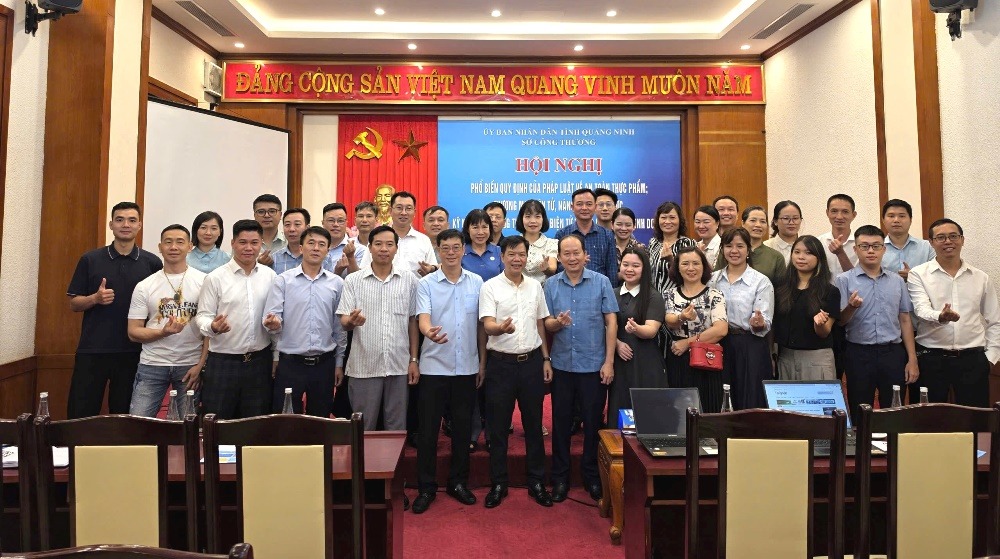
A training conference on e-commerce, jointly organized by eComDX, was recently held in Quang Ninh.
Regarding the criteria group on digital capabilities and skills, the presenter emphasized the need to strengthen practical skills training for businesses, cooperatives, and household businesses; while also enhancing e-commerce management capabilities for staff and disseminating safe online trading skills to the public. Training content is oriented towards new trends such as livestreaming sales, digital marketing, artificial intelligence (AI) applications, digital advertising, and cross-border e-commerce.
Regarding the community ecosystem pillar, Ms. Ly shared several solutions aimed at forming a local e-commerce support network, including building community support groups, online support groups on digital platforms, promoting the role of exemplary business entities, strengthening connections with logistics units, and organizing livestream sessions to promote and sell local specialty products. These are considered important factors contributing to boosting product consumption in the digital environment and enhancing the effectiveness of rural economic development.
Regarding the criteria for evaluating the level of e-commerce implementation, eComDX experts also guided localities on how to determine indicators such as the percentage of online businesses, the level of digitization of OCOP products and typical rural industrial products, the application of traceability using QR codes, and e-commerce revenue. In addition, methods for data collection, quantifying results, and building supporting documentation were introduced to help localities implement the evaluation and assessment process uniformly and smoothly.
Besides the topic of e-commerce, the program also disseminates many contents under the management of the Ministry of Industry and Trade, such as guidance on implementing criteria for rural electricity, commercial infrastructure, industrial cluster development, and promoting the consumption of products from ethnic minority and mountainous regions…
Through the training program, the staff were updated on regulations, implementation methods, and evaluation procedures for the criteria under the National Criteria Set for New Rural Communes in the 2026-2030 period. Regarding e-commerce, the content shared by eComDX contributed to supporting localities in uniformly implementing Criterion 7.3, gradually promoting the application of e-commerce in rural economic development, in line with the national digital transformation orientation and the development of the digital economy in the new phase.